1.1 – Pick your Billionaire

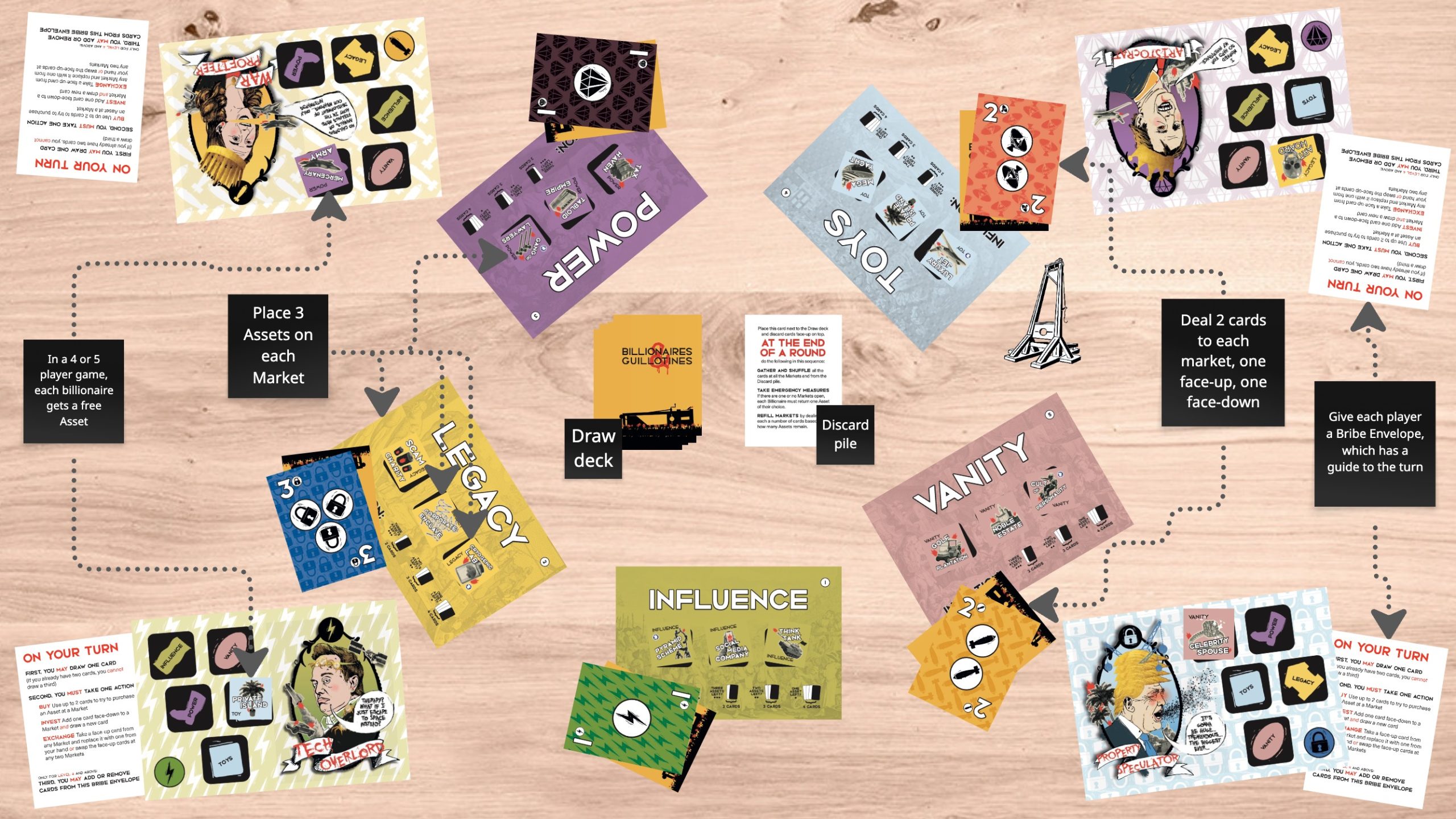
First thing’s first: each player selects one of the five Billionaires sheets: the Tech Overlord, the Property Speculator, the Aristocrat, the Media Baron, and the War Profiteer.
In Billionaires & Guillotine, your objective is to collect five Assets that match the categories on your Billionaire sheet. There are multiple Assets in each of the five categories: Toys, Influence, Legacy, Power, and Vanity.
Your Billionaire also has a special Suit, represented by the icon above their portrait: purple diamonds, yellow bombs, green lightening bolts, blue locks, and peach satellite dishes. This is their special area of domination.
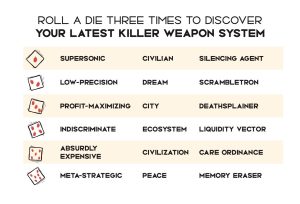
Check out the mini-game on back of your Billionaire cards: roll a die three times, once for each column on the chart from left to right, to find out some fun facts about your plutocrat
1.2 – Set up the markets
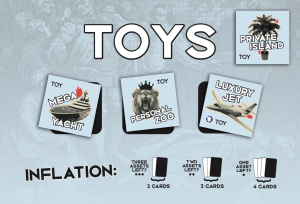
To gain the five Assets you need to win, you’ll need to try and Buy them at Markets.
Place the five Market sheets in an outward-facing circle in the middle of the table.
Place three Assets of the appropriate category on each Market.
If you are playing with 4 or 5 players, give each player one Asset of the category they need two of. Put the unused Assets back in the box.
Place the Guillotine in the middle of the table.
1.3 – Create the draw deck

Gather all the cards with yellow backs and organize them into three kinds: 45 Resource Cards, 12 Crisis Cards, and 4 Special Action cards.
Set aside the Crisis and Special Action cards for now and shuffle only the Resource Cards and place them, face down, in the middle of the table. This is the Draw Deck.
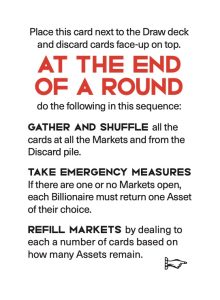 Place the End of a Round card face-up nearby. This will be the Discard pile.
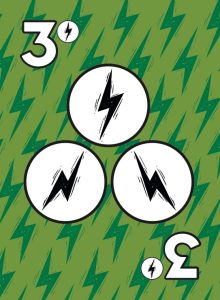 Notice that the Resource cards have scores of one to three. Ones are common, threes are rarer.
These are the cards you’ll use to try and Buy Assets. You’ll notice their suits match those of the Billionaires.
1.5 – The basics
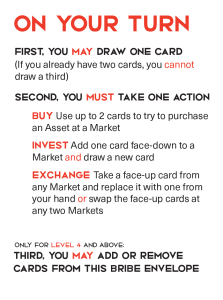 In Billionaires & Guillotines, players go clockwise, taking Turns on which they may draw a card and then they must take one of three actions:
- try and Buy an asset,
- Invest for the future, or
- Exchange cards with one on the board.
A player may only ever have 2 cards in their hand. If you begin your turn with 2 cards, you may not draw a third. It is possible to end a turn with no cards in your hand, that’s ok.
If you have 3 or more cards in your hand, you’ve cheated… which is very much like a Billionaire.
When the Draw Deck runs out of cards, the Round is over and all the cards at the markets will be gathered and shuffled with the discards before the next Round.
1.6 – Try and Buy an Asset

Begin your turn by drawing a card.
Now it’s time to take one of three actions
To use the Buy action,
First announce the Market you want to buy from.
Now play one or two cards from your hand face up on the table and tally their points.
 Next, reveal all the cards at the Market, the face-up one and any face down ones as well.
If the cards from your hand have a sum greater than the sum of those in the market, you win! Collect any Asset at that market and put it on your Billionaire sheet.
However, if the sum of your cards is equal to or less than the market, you lose and don’t collect an Asset.
Win or lose, discard all the cards you used and all the cards from the market.
1.7 – Suit bonus

Remember your Billionaire’s suit?
When you’re trying to Buy and Asset, if you find any cards of that Suit in the Market, they count towards your total.
 For example, let’s say I’m the Tech Overlord and want to Buy the Mercenary Army from the Power Market. I play two cards from my hand, a 1 and a 2, for a total of 3. I now reveal the cards at the market: a 2 and a 3. But because the 2 is in the green lightening-bolt suit, it counts towards my points. So now my 5 points beat the 3 in the market, and I win.
You can Buy assets you don’t need in order to win, perhaps to keep them away from your rivals.
You can also try and Buy with only one card from your hand if you feel especially confident.
1.8 – Inflation
Win or lose, all the cards involved in the Buy action are now discarded, both those that you played and those from the Market.
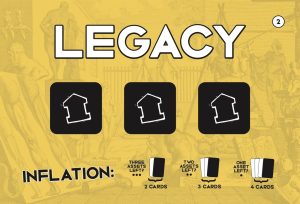
Before the end of your turn, it’s time to refill the Market for the next player. The number of cards will depend on the number of Assets that remain because of inflation: as Assets become scarcer, their price increases.
If you were unsuccessful, and all three Assets remain, deal the same number of cards as before: 1 face-down and 1 face-up.
But if you were successful, and now only two Assets remains, the cost goes up: deal 2 cards face-down and 1 face-up.
In the future, if there is only one Asset remaining, you’ll deal 3 cards face-down and 1 face up. It’s all indicated on the bottom of the Market sheet.
1.10 – Pause here and play a practice round
I suggest you pause play a few practice turns now and try out all three actions, to get the hang of things.
Don’t overthink it: Billionaires & Guillotines is a fast-paced game and fortunes are made and lost quickly. Be a bit reckless, like a real billionaire!
It can be tempting to Buy all the time, but don’t forget to Invest and Exchange as well. It can be very important.
You are permitted to Buy assets you don’t need (maybe to keep them away from your opponents).
 If there are no Assets left at a Market, it is closed (there are ways to get Assets returned later). Flip it over: the billionaire who bought the last Asset gets to answer the personality question on the back!
Oh and one more thing: if you cheat in Billionaires & Guillotines (for example by having more than two cards in your hand) and another player correctly accuses you of it, you must return one asset of their choice to its Market. But if another player accuses you incorrectly, they must give back an asset of your choice.
1.11 – At the end of the Round
The Round ends when there are not enough cards in the Draw Deck. Pause the game.
Players keep the cards in their hands.
But all the other cards are shuffled and become a new draw deck (those at the markets and those in the discard pile) .
Now deal cards to the Markets based on how many Assets remain at each, based on Inflation (two cards if 3 Assets remain, three cards if there are 2 Assets, four cards if there is only 1 Asset). If there are no Assets left, the market continues to be Closed.
If only one Market is open, Emergency Measures must be taken: all players must give one Asset of their choice back to the market.
Now play resumes. The Poorest Player goes first: this is the player with the fewest Assets they need to win.
1.12 – Adding Special Action cards
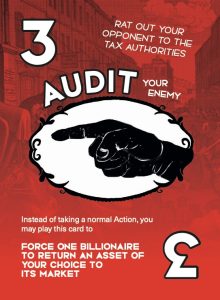
Now that you’ve got the hang of the basics, let’s add the four Special Actions cards to the Draw Deck.
These cards can be played like a regular suitless resource card. If played form your hand, they count towards your attempt to Buy an Asset; if they are found in a Market, they count against your attempt to buy.
But if you have one of these cards in your hand, you can also use these cards’ Special Actions on your turn, instead of taking an action.
You can discard the Audit card to force any billionaire to return an Asset of your choice to its Market. Don’t adjust the number of cards at the market.

You can discard the Scam card to take an asset from another player and give them an asset of your choice in return. However, you cannot use power this to get the fifth Asset you need and win the game.
 The Game the Market card is a bit tricky, because it’s in two part.
- First, gather up all the cards at all of the markets and shuffle them. Then deal them face-down to all markets equally, discarding the remainder (remember: the top card at each market should be face-up).
- Second, you may (but don’t have to) now use this card as part of an attempt to Buy an asset, counting its score (2) and another card from your hand (if you want).

2.1 – Setting up
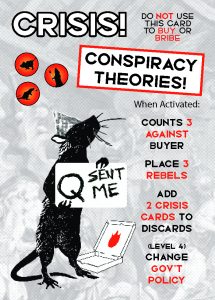
Shuffle the 12 Crisis cards. Add four of them to the Draw Deck.
Place the Guillotine where everyone can see it, with some room around it.
 Place the Rebel tokens nearby.
Shuffle the Panic! cards and keep them face-down, nearby.
If you’re levelling-up mid-game, simply draw one Crisis card at random and place it near the Guillotine. Place as many Rebel tokens on top as there are rebel icons on the crisis card.
2.2 – Discovering a Crisis card
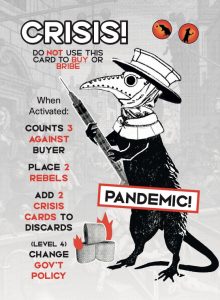
Since there are 4 crisis cards in the deck, you might encounter them in one of two places:
If a Crisis is face-up on a market, nothing happens… yet!
But when someone tries to Buy an Asset and a Crisis is found in the market (face-up or face-down), it is Activated, which is explained below.
If you draw a Crisis card to your hand, nothing happens immediately. You cannot use it to try and buy an asset (this would be like a billionaire intentionally unleashing a crisis).
But you can use it to sabotage others! Invest it in a pile face-down, or Exchange it for a face-up card.
It’s very important to remember: you can never use a Crisis card to try and Buy an asset. It’s useless to you. It can only be Invested or Exchanged.
2.3 – Activating a Crisis

A Crisis is Activated when someone tries to Buy and finds it in a Market. Then three things happen:
First, it makes the Asset more expensive by three. You can still win the Asset, but it’s harder.
Next, no matter if you win or lose the asset, place the activated Crisis near the Guillotine and place as many Rebel tokens on top as their are icons on the card.
Finally, add two more Crisis cards to the Discard pile (the chance of a Crisis increases!)
So, for example, let’s say I’m, the War Profiteer and I want to buy the Cryogenic Lab from the Legacy Market. There is the Killer Robots Crisis card face-up there, but nothing happens until I try and buy it. When I try and buy it counts 3 against my hand of 5 points, but because there was also a 3 in my suit (yellow bombs) in the Market, I still win, and collect the Asset. But regardless of my victory, the Crisis is activated. I place it near the Guillotine and add the three Rebels indicated. I now add two new Crisis cards to the Discard pile.
If more than one Crisis card is found in a market, discard all but the one with the greatest number of Rebel icons on it.
2.4 – Revolution and Panic!

As the game unfolds and more Crises are unleashed, more Rebels gather near the Guillotine.
When all 10 Rebels have gathered, that’s it! There is a Revolution and all the Billionaires… er… well… it’s game over for them. Nobody wins.
But wait! On the brink of Revolution, the Billionaires have one chance to cooperate.
 The first time that 7 or more Rebels have gathered, finish the current player’s turn, then pause: it’s time to Panic!
The player who caused the last Crisis draws a card at random from the Panic! deck. This represents an opportunity for the Billionaires to work together to undermine the revolution, so show it to everyone.
On the Panic! card, there are three Asset categories. The Billionaires must now negotiate to sacrifice one asset from each of these categories by returning them to the Market.
 If the negotiation and sacrifice are successful, the player who caused the last crisis rolls the die: remove this many Rebels from the Crisis cards. Keep the Crisis cards in place, even if they have no Rebels left on them.
There are no rules to govern the negotiations. One player may sacrifice all three Assets, or three players may give up one each, or any combination.
If If the negotiation isn’t successful, nothing happens, and no Assets are sacrificed. Put all the Panic cards back in the game box: the Panic! phase is over, and it only ever happens once per game.
The game continues with the next player. If sacrificed assets are returned to their market, do not adjust the number of cards.

3.1 – The luxury bunker

You can’t put a price on safety. That’s why in level 3 of Billionaires & Guillotines we introduce the Luxury Bunker.
The player with the Luxury Bunker is immune to the three point penalty if they activate a Crisis card (however, the crisis is still activated and rebels gather on it).
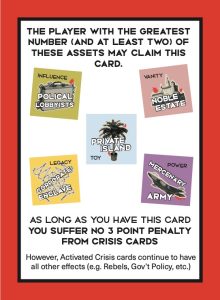 A player can claim the Luxury Bunker for free when they have at least two of the following Assets: The Corporate Enclave (Legacy), the Mercenary Army (Power), the Noble Estate (Vanity), Political Lobbyists (Influence), or the Private Island (Toys).
If that player no longer has at least two of these Assets, they lose the Luxury Bunker.
If another player has a greater number of these Assets, they can steal the Luxury Bunker immediately.
3.2 – Billionaire Roles
Of course, billionaires don’t need jobs, but they do like to give back to society…
In Billionaires & Guillotines, Roles give you special powers or winning conditions.
You can only ever have one Role at any time, but every Round, you’ll have a chance to exchange your roles and change your strategy.
Role cards usually remain secretly in your hand until you choose to Reveal them on your turn and use their power.
You can choose not to have a Role if you like.
There are nine Roles in Billionaires & Guillotines, but let’s set aside the three green Role cards until we get to Level 4.
3.3 – The Banker and the Scam Artist

You can Reveal the Banker card and, for the rest of the Round, you may have up to three cards in your hand, but you still can only Buy with two cards.
 You can Reveal the Scam Artist card to choose an Asset owned by another player. That player must either
- return that Asset to its Market,
- or give it to you in return for one of your Asset, which you choose.
3.4 – The Gangster and the Disaster Speculator

When you Audit an opponent, you can can Reveal the Gangster card to take an Asset directly from your opponent.
But you can’t use this to win the game, in other words to get the fifth Asset you need.
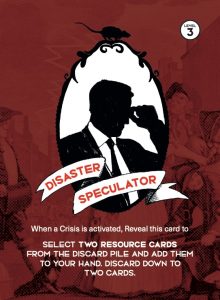 If you’re the Disaster Speculator, you can Reveal your card after a Crisis is resolved to take any two cards from the Discard pile to your hand, then discard so you only have two cards left in your hand.
3.4 – The Power Broker and the Celebrity
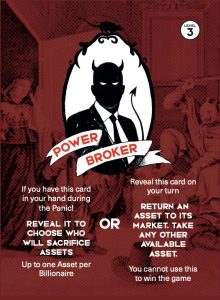
The Power Broker is a little complicated because it has two powers.
If you have this card during the Panic! phase, you can reveal it to dictate who has to make the Sacrifice, up to one Asset per Billionaire.
Otherwise, you may Reveal the Power Broker card on your turn to take an Asset from any market and return one Asset to its market, but you can’t use the power to win the game.
 The Celebrity is an especially important card.
Keep it hidden, but reveal it if the game ends in a Revolution. You win! Your adoring fans spare your life!
However, if it was you who activated the Crisis that led to the Revolution, you lose with everyone else.
4.1 – Setting up
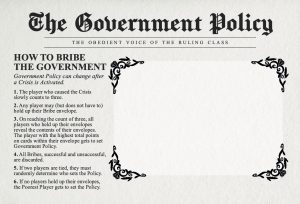
The Government Policy changes every time there is a Crisis, and at the end of each Round.
Players can put cards in their Bribe Envelopes and use it to bet against one another.
We’ll go over the possible policies first, then, explain how to bribe.
 For now, place the Government Policy sheet and the 10 Policy Cards somewhere within reach of all players.
You can also add the three remaining green Role cards to the others. Read them out loud so everyone is familiar with them.
4.2 – Billionaire Suit advantage Policies

As we all know, Billionaires rely on subsidies, tax breaks and sweethearts deals from the government to get ahead.
If the Government Policy is set to any of the five Billionaire suits, all cards of that suit are doubled in value in all circumstances.
 While this could be of some advantage to any billionaire, it’s usually much more rewarding to the billionaire whose suit is featured because all cards of that suit count towards their score when they try and buy.
This doubling bonus also affects cards in Markets and Bribe envelopes.
4.3 – “Billionaire Audited” and “Archeological Dig”
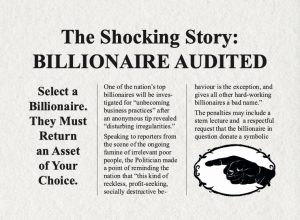
When a player sets the “Billionaire Audited” policy, they may pick one Asset held by another player and force that player to return that Asset it to its market, just like the Audit card.
 If that player is also the Gangster, they can steal the Asset directly.
When a player sets the “Archeological Dig” policy, they may take any two cards from the Discard pile into their hand, then immediately discard down to two cards (unless they are the Banker, in which case they can have three cards).
4.4 – “New Role” and “Repress the Rebels”
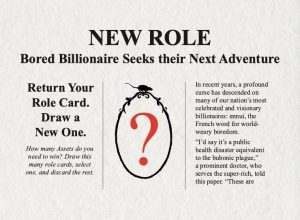
When a player sets the “New Role” policy they can return their revealed or unrevealed Role card to the deck. Then, they may randomly and secretly draw as many Role cards as the number of Assets they need to win and keep one (the same process as at the end fo the round, outlined in step 3.6).
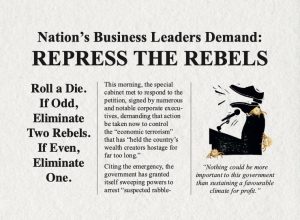 When a player sets the “Repress the Rebels” policy, they roll the die. If it’s odd, they may remove two rebels of their choice from the Crisis cards near the Guillotine; if it’s even, just remove one. Leave the Crises cards in place, even if they have no Rebels left on them.
4.5 – “Tax Tyranny”
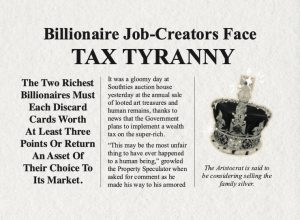
When the “Tax Tyranny” policy is set, the two richest players (those who have the most Assets they need to win) both must either discard cards from their hand worth a total of at least three points, or return an Asset of their choice to its Market.
In case of a tie between the richest players, roll a die.